
Walking, wildlife and cultural holidays in Andalucia
- Capital: Sevilla.
- Area: 87,268 km²
- Provinces: Sevilla, Huelva, Cadiz, Cordoba, Malaga, Jaen, Granada, Almeria
If you’re a fan of natural parks and enjoy walking or wildlife holidays, Andalucia is the perfect destination for you. This beautiful region is home to a multitude of natural parks that are designed to protect and preserve the unique and diverse landscapes, flora, and fauna found throughout the area. Not only do these parks provide a safe haven for a variety of species, they also offer a wide range of outdoor activities such as hiking, wildlife viewing, and nature observation. Whether you’re a seasoned nature enthusiast or simply looking for a peaceful getaway, Andalucia’s natural parks are sure to provide you with a memorable experience.
Listen to me (Clive) describing this article
Andalucia from a nature lovers point of view
Andalucia is the second largest autonomous community in Spain.
Its topography is marked by the depression of the Guadalquivir River Valley, which runs between two mountainous areas: the Sierra Morena mountains to the north and the Betica ranges to the south.
The Guadalquivir river has created a fertile valley, its source is in the Sierra de Cazorla Natural Park in the east and its estuary in the south-west marshlands of Doñana National Park.
- Fifty percent of the Andalucian territory is mountainous with one-third found at an altitude above 600 metres. This includes an extensive high plateau and 46 peaks higher than 1,000 metres.
- Eighteen percent of its territory is protected.
- The Sierra Nevada mountain range holds the highest point in Andalusia, the main peaks Mulhacén and Veleta, both measure over 3,400 metres high.
Family-Friendly Wildlife Holidays in Andalusia: Top Stays for Nature-Loving Travelers at booking.com
Looking for a family-friendly getaway filled with nature and adventure? Search for and find the best hotels and stays in Andalusia for wildlife holidays. From national parks like Doñana and Sierra de Grazalema to beaches along the Costa de la Luz, Andalusia offers unique outdoor experiences for kids and parents alike. Discover spacious accommodations, nature lodges, and eco-resorts perfect for exploring the region’s rich wildlife and natural beauty.
Find hotels across Andalucia and all of the natural and national parks over at booking.com.
Antonio Banderas promoting Andalucia as a tourist destination
Andalusia is also the meeting place between the Atlantic ocean and the Mediterranean sea at the strait of Gibraltar. The proximity between two continents at the strait, encourages migrating birds to collect together while waiting for good weather conditions to assist their journey outward and a resting place on the return. Enormous flocks of birds gather, allowing bird watchers to see species that can be difficult to observe in their normal terrain.
Where is Andalucia?
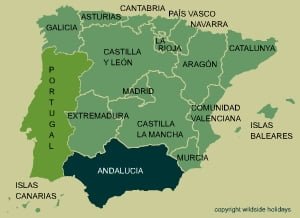
Andalusia is located in the south of the Iberian peninsula, in southwestern Europe. South of the autonomous communities of Extremadura and Castilla-La Mancha. West of the autonomous community of Murcia and the Mediterranean Sea. East of Portugal and the Atlantic Ocean. North of the Mediterranean Sea and the Strait of Gibraltar.
- This Spanish province is the only European region with both Mediterranean and Atlantic coastlines.
- The small British overseas territory of Gibraltar shares a three-quarter-mile land border with the Andalusian province of Cádiz at the eastern end of the Strait of Gibraltar.
The main mountain ranges of Andalusia are the Sierra Morena and the Baetic System, consisting of the Subbaetic and Penibaetic Mountains. These are separated by the Intrabaetic Basin. In the north, the Sierra Morena separates Andalusia from the plains of Extremadura and Castilla La Mancha on Spain’s Meseta Central. To the south the geographic subregion of Upper Andalusia lies mostly within the Baetic System, while Lower Andalusia is in the Baetic Depression of the valley of the Guadalquivir.
Tours in Andalucia from Viator
Andalucia has a vast array of sites to visit and enjoy. Below are some of the options listed on the Viator website. (We recieve a small commission if you book a tour which doesn’t cost you more and helps us to keep Wildside Holidays up to date with the best information.)
Natural and National Parks in Andalucia
If you are looking for Walking and wildlife holidays in Andalucia then heres the place to start. The list of all of the natural and national parks in Andalucia.
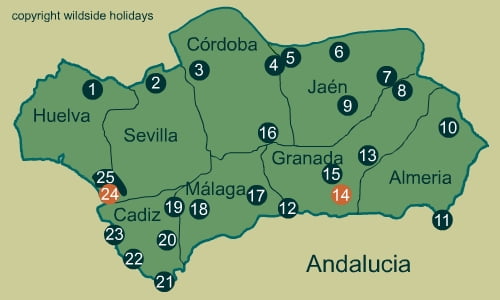
Andalusia boasts an extensive network of Protected Natural Areas, encompassing a variety of stunning landscapes. The region is home to 24 natural parks, 28 nature reserves, 32 natural sites, two protected landscapes, 60 natural monuments, 21 peri-urban parks, five concerted nature reserves, and three national parks, including the recently designated Sierra de las Nieves National Park. These designations, declared at the community level and incorporated into the Natura 2000 Network, contribute to the overall conservation efforts. Additionally, Andalusia accommodates 63 Areas of Special Protection for Birds (ZEPA), 190 Places of Community Importance (LIC), and 176 Special Conservation Areas (ZEC).
In terms of international recognition, Andalusia showcases a remarkable commitment to protecting its natural heritage. The region proudly boasts nine Biosphere Reserves, 25 wetlands designated as Ramsar Sites, four specially protected areas of importance for the Mediterranean (ZEPIM), and three geoparks. Furthermore, the prestigious UNESCO has designated Doñana as a World Heritage Site.
Nature reserves, predominantly characterized by their wetland environments, albeit smaller in size compared to parks, play a vital role in preserving rich flora and fauna, particularly avian species. Other notable protected areas, though relatively smaller, include natural sites such as the karstic rock formations of Torcal de Antequera and the iconic desert of Tabernas in Almería, the sole desert on the European continent.
Here are the national and national parks in Andalucia. Just click the links to find out more about each protected area.
- Sierra de Aracena y Picos de Aroche The village of Jabugo, one of the 28 within the park, produces world renowned Jamon Iberico products. The museum of ham in Aracena is well worth a visit. (Not for vegetarians though)
- Sierra Norte de Sevilla The Sierra Norte de Sevilla shares with its neighbouring parks endangered creatures such as the Lynx, Black stork and Imperial eagle. Evergreen oak trees dominate the terrain, interspersed with meadows or dehesas.
- Hornachuelos This parkland covers the eastern end of the Sierra Morena, close to Cordoba. The western part of this range is divided into a further two parks as it is dissected by provincial borders, thus forming an extended belt of protection. Sierra Norte de Sevilla is within the province of Sevilla. Sierra de Aracena y Picos de Aroche is in Huelva province.
- Sierra de Cardeña y Montoro Located on the north eastern border of Cordoba and is separated from the natural park of Andújar in Jaen by the deeply ravined river Yeguas. There are cultivated fields along with Cork and Holm oak forests plus dense natural Mediterranean scrub.
- Sierra de Andujar The northern edge borders with Ciudad Real, a province of Castilla la Mancha. To the west is the Cardeña y Montoro natural park, the two parks only being separated by the river Yeguas. There are two reservoirs in the eastern side of the park, Embalse del Jándula and Embalse El Encinarejo.
- Despenaperros is a natural mountain pass connecting Andalucia with Castilla la Mancha through the Sierra Morena mountain range. The rock structure forms a dramatic landscape with vertical cliffs and unusual rock formations.
- Sierra Cazorla The Sierra Cazorla, Segura y las Villas offers a great array of very well conserved ecosystems, each of high natural value with many endemics. Spectacular landscapes including waterfalls, deep valleys and lakes make this park unique.
- Sierra de Castril There are two outstanding cave formations, both in the Sierra Seca area of the park. The Cueva de Don Fernando is Granada’s largest cave and the second biggest in Andalucia. This 2.5km long cave drops to an amazing 241m below sea level. The Cueva del Muerto has spectacular stalactites and stalagmite formations
- Sierra Magina The exposed rocky peaks, vertical cliffs, shaded woodland, river banks and extensive Olive and Almond groves each offer a different habitat.
- Sierra de Maria los Velez Traditional lifestyles continue in the area such as keeping sheep and goats, cutting timber, logs and collecting resin and almonds along with a new introduction, distilling essential oils from aromatic plants.
- Cabo de Gata-Níjar Grey and purple heron, cranes, storks, black-winged stilts, oystercatchers and avocets can all be observed at the salinas (salt flats separated from the sea by a sand bar), as well as thousands of flamingos.
- Sierras de Tejeda, Almijara y Alhama The parkland of Sierras de Tejeda Almijara y Alhama is limited in the south east by the Mediterranean sea and rises in craggy mountains towards the north west. 52% of the park is in Granada province with 48% in Málaga province.
- Sierra de Baza with its limestone peaks over 2000m is a relatively humid, botanical jewel between two arid plains of Las Hoyas de Guadix-Baza and the Llanos del Marquesado.
- Sierra Nevada Declared a National Park in 1998 and encompassing an area of 86,208 hectares it is a popular destination throughout the year. It holds an exceptional variety of animal and plant life due to the combination of altitude and its proximity to the Mediterranean sea.
- Huetor Situated just north east of Granada on a main arterial route the natural park area of Huetor is limestone mountain terrain with typical features such as steep sided ravines, mixed woodland and Mediterranean scrub
- Sierra Subbética Set in the middle of Andalucia the Sierra Subbética is a limestone semi-mountainous area with a rolling hills and a high point of 1.570 m named la Tiñosa. The main economy comes from olive oil, therefore much of the area has intensive olive grove plantations.
- Montes de Malaga The Montes de Málaga natural park is just 5km from the city of Málaga. It consists of rolling hills and mountains with a high point of 1031m. The highest road pass is Puerto de León at 960m.
- Sierra de las Nieves In the summer of 2021 The Sierra de las Nieves Natural Park was upgraded to NATIONAL park status. It covers a huge area of approximately 300 square kilometres with its limits ranging from Marbella inland to include the villages of El Burgo, Istan, Monda, Parauta, Ronda, Tolox and across to the Sierra Bermeja close to Estepona.
- Sierra de Grazalema The Natural Park of the Sierra de Grazalema has also been declared a Biosphere Reserve, this is due to the diverse geography with high limestone mountains and deep gorges such as Garganta Verde, (Green Gorge) that is 400m deep and filled with lush vegetation. In addition, it offers a great diversity of species- animals and vegetation.
- Los Alcornocales Los Alcornocales is a forest of Cork oak trees, the largest in Iberia and therefore important to the worlds cork supply. The park, which also embraces mountains, creates a green corridor from the Sierra de Grazalema natural park through to the coastal zone at Tarifa.
- El Estrecho (The Strait of Gibraltar) natural park covers the southern most tip of Spain, containing within it environs a richness of history, vegetation and especially bird and marine life.
- La Breña y Marismas de Barbate Although one of the smaller parks in Andalucia it has 28km of marked pathways and covers both land and marine areas. 100 metre cliffs drop vertically into the powerful Atlantic ocean. Above the cliffs is a dense woodland of Stone pines (Pinus pinea) which create a naturally rounded canopy of shade. As well as the pine woods and marine zone there are moving dunes and wetland where the Barbate river reaches the Shore.
- Bahia de Cadiz The tidal marsh of Sancti Petri, which is situated in Chiclana de la Frontera, to the south of the Bay of Cádiz and which forms a part of this natural park, is an area of high scenic value, given that is one of the few marshes that has not been altered by its use as a salt mine.
- Doñana National Park Used as hunting grounds for royalty from the 14th century, it was made a reserve in 1963 and a national park in 1969, and it remains the largest protected area in Europe.
- Doñana Buffer Zone: As well as the National Park of Doñana there is also a buffer zone (or pre-park area) around it, which is a designated Natural Park of Doñana (known in Spanish as Entorno de Doñana).
- The Natural Park is less strictly protected with more open access but being a natural continuation of the National Park it is also of great importance for migratory and breeding birds, wildlife in general and tourism for the area
Biosphere reserves in Andalucia
Below is the list of biosphere reserves in Andalucia, each one with a link to the relevant protected area information pages published here at Wildside Holidays. Remember that many of these areas have been previously declared as Natural or National parks before being incorporated into the much larger zones (hence two declaration dates for some biospheres, the first being the Natural Park declaration date).
- Cabo de Gata – Nijar – Almería – 1997
- Doñana – Huelva y Sevilla – 1980
- Sierra Nevada – Granada – 1986, 2012
- Sierra de Cazorla, Segura y las Villas – Jaén – 1983
- Sierra de Grazalema – Malaga, Cádiz -1977
- Sierra de las Nieves – Málaga – 1995
- Dehesas de Sierra Morena – Huelva, Sevilla y Córdoba – 2002
- Marismas de Odiel – Huelva – 1983, 2018
Global Geoparks in Andalucia
Andalucia also has global geoparks. (UNESCO Global Geoparks are single, unified geographical areas where sites and landscapes of international geological significance are managed with a holistic concept of protection, education and sustainable development.) Information can be found here: https://wildsideholidays.co.uk/global-geoparks-in-spain/
Other protected areas in Andalucia
- El Torcal de Antequera
- El Chorro and the Caminito del Rey (Desfiladero de los Gaitanes Protected area)
- The Tabernas Desert in Almería
- Laguna of Fuente de Piedra
Botanical gardens in Natural parks of Andalucia
Created in 2001, The Andalusian Network of Botanical Gardens has worked pretty hard over the years to benefit the conservation of biodiversity, education , recovery and reintroduction of wild species. The network is made up of 12 Gardens located within Natural and National park areas of Andalucia.
If you are visiting an area where a botanical garden is located then it really is worth a visit. Many of the plants that you will see whilst walking in the countryside of Spain are represented in well laid out and labelled areas.
I have found that the people staffing these botanic gardens are some of the most friendliest and knowlegdable people working within the natural park system in Spain.
- El Aljilbe in Alacala de los Gazules (Los Alcormocales Natural Park)
- El Castillejo in El Bosque (Sierra de Grazalema)
- Detunda-Cueva de Nerja – Sierras de Tejeda, Almijara y Alhama
- Dunas del Odiel – Paraje Natural de las Lagunas de Palos y las Madres
- El Albardinal Cabo de Gata-Níjar
- El Robledo – Sierra Norte de Sevilla
- Hoya de Pedraza – Sierra Nevada
- La Cortijuela – Sierra Nevada
- Micológico La Trufa – Sierras Subbéticas
- San Fernando – Bahia de Cádiz
- Torre de Vinagre – Sierras de Cazorla, Segura y las Villas
- Umbria de la Virgen – Sierra de María loz Velez
Natural and National Parks in Andalucia. Is it a Natural or National Park?
In Spain, a natural park (Spanish: parque natural) is a natural space protected for its biology, geology, or landscape. As is to be expected, natural parks focus their main attention on the conservation and maintenance of flora, fauna, and terrain. Natural parks may be maritime or terrestrial and can be in the mountains, along the coasts, in the desert.
Human habitation and Agriculture has affected in one way or another the habitats in a natural park area.
A National park (Spanish: parque nacional) Has the same if not more protection status. More of a wilderness area less impacted by human habitation and exploitation.
FAQ – Natural and National Parks in Andalucía, Spain
Andalucía offers one of Europe’s most diverse natural landscapes, making it perfect for walking and wildlife holidays. The region includes mountains, wetlands, coastal deserts, and forests, home to rare species like the Iberian lynx and Spanish imperial eagle. Its unique location at the Strait of Gibraltar makes it a vital stopover for migratory birds, ideal for birdwatching. Outdoor activities like hiking, wildlife observation, and photography are available year-round in protected areas across the region.
How extensive is the protected natural territory in Andalucía?
About 18% of Andalucía’s land is under protection. The region includes:
3 National Parks (e.g., Doñana, Sierra Nevada, Sierra de las Nieves)
24 Natural Parks
28 Nature Reserves
60 Natural Monuments
32 Natural Sites
Plus international recognitions:
9 Biosphere Reserves
25 Ramsar wetlands
3 UNESCO Global Geoparks
63 Special Protection Areas for Birds (ZEPA)
190 Sites of Community Importance (LIC)
This extensive network helps protect Andalucía’s ecosystems and supports ecotourism across the region.
Natural Parks preserve landscapes where humans have traditionally lived or worked, often including sustainable agriculture or small villages. National Parks, by contrast, offer stricter protection for wilderness areas with minimal human influence. Both aim to conserve biodiversity but differ in allowed activities and conservation focus.
What are the most notable Natural and National Parks in Andalucía?
Some of the top parks include:
Sierra Nevada National Park – Home to Spain’s highest peaks outside the Pyrenees and rich in endemic species.
Doñana National Park – A UNESCO World Heritage Site vital for bird migration and wetland ecosystems.
Sierra de Grazalema Natural Park – Known for its limestone gorges, vultures, and high rainfall.
Cabo de Gata-Níjar Natural Park – A volcanic coastal park famous for flamingos, dry landscapes, and salt flats.
Sierra Cazorla, Segura y Las Villas Natural Park – One of Spain’s largest protected areas, with dense forests and waterfalls.
Los Alcornocales Natural Park – Iberia’s largest cork oak forest and a key ecological corridor.
Sierra de las Nieves National Park – Upgraded to national park status in 2021, featuring unique flora and dramatic mountain landscapes.
Andalucía’s parks showcase stunning geological diversity.
El Torcal de Antequera – Karstic rock formations and natural labyrinths.
Sierra Subbética – Rolling limestone hills with fossils and rugged peaks.
Cueva de Don Fernando (Sierra de Castril) – Granada’s deepest cave.
Tabernas Desert – Europe’s only true desert, with cinematic rock formations.
Despeñaperros – A dramatic natural pass with vertical cliffs and historic importance.
The region is also home to three UNESCO Global Geoparks, highlighting geosites of international scientific value.
Yes. The Andalusian Network of Botanical Gardens includes 12 gardens located within or near protected parks. These focus on native plants, education, and the reintroduction of threatened species. Each site features labeled trails and knowledgeable staff, making them excellent stops for visitors interested in Mediterranean flora.
Spring and autumn are ideal due to mild weather and increased wildlife activity. Summer can be very hot, especially in lowlands and deserts, though coastal and high-altitude parks remain accessible. Winter is good for birdwatching and exploring milder southern areas.
The Strait of Gibraltar is one of the world’s most important bird migration bottlenecks. Thousands of raptors, storks, and passerines cross between Europe and Africa twice yearly. Wetlands like Doñana, Fuente de Piedra Lagoon, and Cabo de Gata’s salinas host flamingos, spoonbills, and rare waterfowl.
Yes. Wildside Holidays connects visitors with experienced naturalist guides for walking holidays, wildlife tours, and birdwatching trips. Many parks have visitor centers with interpretive trails, observation hides, and educational programs.
Andalucía spans coastlines, wetlands, forests, and high mountains. This topographical variety, combined with its location at the intersection of Europe and Africa, creates diverse microclimates. These support an unusually high number of species, including many found nowhere else in Europe.
About Clive, the author of this article.
I’ve been living in this lovely area of Western Andalucia for the last 20 years or so and dedicate most of my time to the running of English language tourist information websites for the towns of Cádiz, Ronda, Grazalema, the famous or infamous Caminito del Rey, and also Wildside Holidays, which promotes sustainable and eco-friendly businesses running wildlife and walking holidays in Spain.